
A Good Life Can Still Be the Wrong Life for You Now.
Sep 26, 2026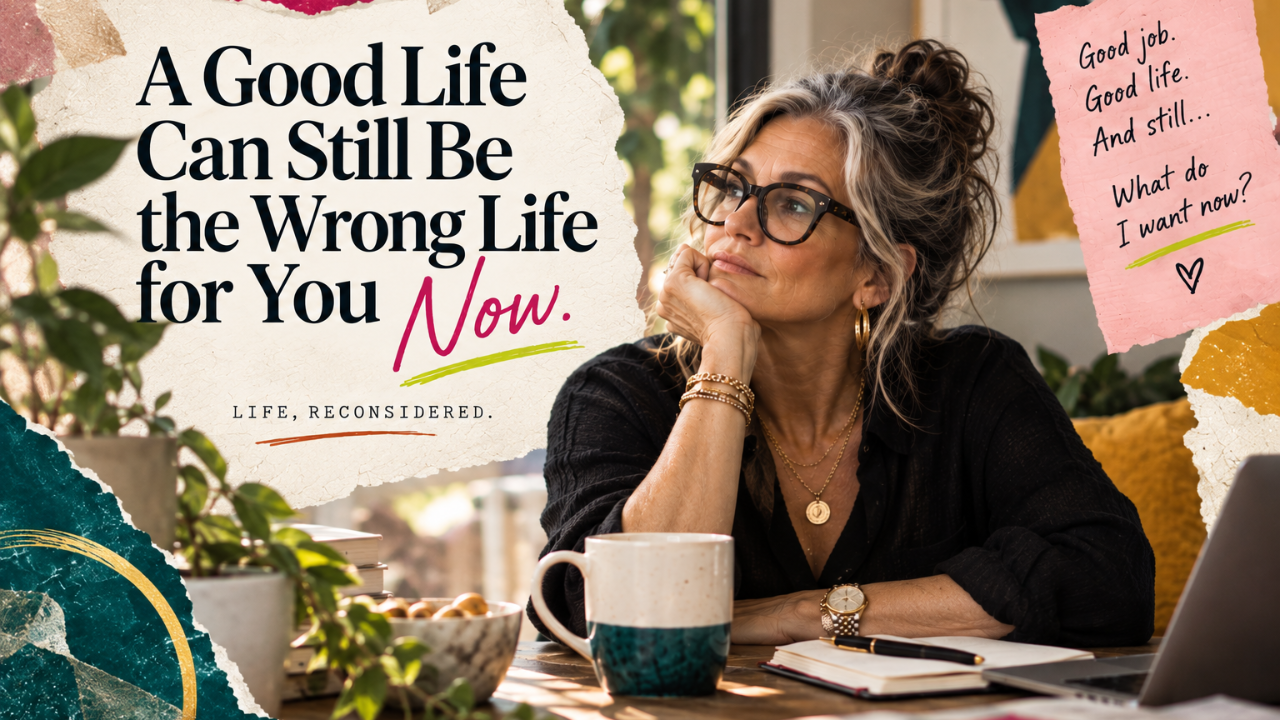
Here's something we're apparently not supposed to say:
You can have a good life and not want all of it anymore.
Not a terrible life. Not a life that's fallen spectacularly apart and given you a perfectly acceptable reason to change everything.
A good life.
Maybe even a life you once desperately wanted.
And you can still reach a point when something inside you says, I don't think I want this anymore.
That's an uncomfortable thing to admit, especially when nothing is obviously wrong. Before we've even finished thinking it, another voice usually barges in with a clipboard.
But you should be grateful. Look at everything you have. Other people would love your life. Don't be selfish. What exactly are you complaining about?
And my personal favorite: Maybe you just need to appreciate what you have.
Maybe.
Or maybe gratitude has absolutely nothing to do with it.
Gratitude Is Not a Lifetime Contract
I can be grateful for something and still be finished with it.
I can love what a career gave me and decide I don't want to do it anymore. I can treasure a season of motherhood and be ready for a life that isn't organized entirely around my children. I can appreciate a friendship and recognize that we've grown apart.
I can honor the woman I was when I made a choice and allow the woman I am now to make a different one.
That was right for me then. This isn't right for me now.
Both can be true.
We understand this perfectly well with less important things. Nobody expects you to keep wearing the same shoes because you once loved them.
Nobody says, "But Mary, those were wonderful shoes. Think of all the places they took you."
They're shoes. They fit until they didn't.
Apparently, we reserve existential guilt for careers, relationships, identities and major life decisions. Those we're supposed to keep forever because we once chose them enthusiastically.
That seems like a questionable system.
What If Nothing Is Wrong?
I think this may be one of the hardest things to accept.
We're comfortable changing something when there's a clear problem. If the job is toxic, the relationship is terrible or you're completely miserable, there's a neat little story everyone understands.
Something is wrong, so change makes sense.
But what happens when the job is fine? The relationship is fine. Your house is fine. Your life, from the outside, may be more than fine.
You're just not the same woman who chose it.
Well, shit.
Now what?
There's no villain or catastrophic event you can point to when somebody asks why. There's just a growing awareness that something which once felt like home doesn't feel quite the same anymore.
That's harder to explain, so we're very good at explaining it away.
Maybe I'm restless. Maybe I'm bored. Maybe I need a vacation, a hobby or more magnesium.
Apparently magnesium fixes everything now.
Or maybe, stay with me here, we've changed.
Women Are Allowed to Evolve. In Theory.
We love talking about growth until growth becomes inconvenient.
We're encouraged to know ourselves, find our voices and become more confident. Just please make sure that newfound voice doesn't announce that it wants anything different from what everybody has gotten used to.
That's when personal growth becomes considerably less inspirational.
Because real change affects things. It can affect relationships, schedules, money, expectations and other people's comfort.
And that's often when we start negotiating against ourselves.
Maybe it's not that important. Maybe I can wait another year. Maybe this feeling will pass.
So we keep going, not necessarily because we're choosing the life again, but because we chose it once.
There's a difference.
I've been sitting with a question lately:
If I woke up today with none of my previous decisions already made, what would I choose now?
I'm not suggesting everyone quit their jobs, leave their spouses, sell their houses and move to Portugal because a blog post made them feel something on a Thursday afternoon.
Please don't do that.
I'm talking about getting curious.
Would I choose this career again? Would I organize my days this way? Would I keep defining success like this? Would I continue saying yes to this thing?
And maybe the most revealing question of all:
If nobody were disappointed by my answer, what would I want?
That question can expose some shit.
Other People Get Used to Our Versions Too
Sometimes the thing keeping us in place isn't fear of change itself. It's fear of what our change will mean to somebody else.
We build relationships around patterns. She's the strong one. She's easygoing. She handles that. She doesn't mind. She'll understand.
Then one day the strong one says she's tired, the easygoing one becomes a little less easygoing, or the woman who "never needed much" starts wanting things.
Suddenly everybody is confused.
What's gotten into you?
Maybe nothing.
Maybe you're simply questioning an agreement you never consciously made but have been honoring for twenty years.
That doesn't mean the people around you are terrible. They may simply be accustomed to a version of you that you've begun to outgrow.
And here's the really inconvenient part: you may be accustomed to her too.
Outgrowing Something Doesn't Make It a Mistake
I want this on a very large sign somewhere.
We seem to have this idea that if we don't want something anymore, maybe we were wrong to want it in the first place.
I don't believe that.
You were different. Your circumstances, needs and priorities were different. The woman you were made choices based on what she knew and wanted at the time, and some of those choices may have given you extraordinary things.
People you love. Security. Skills. Memories. Confidence. Maybe even the strength required to question some of those choices now.
You don't have to make your past wrong to make your future different.
Something can have been absolutely right and still be over.
At 62, I don't want everything the woman I was at 32 wanted.
Thank God. She had some questionable ideas.
She also had dreams that mattered enormously to her. Some came true, some didn't and some I simply don't care about anymore.
That's not failure.
That's a life.
Returning to yourself, at least as I understand it now, isn't about finding one fixed identity and protecting it forever. It's about becoming more willing to notice who you are now.
That's a moving target, which is inconvenient if you're looking for a tidy answer but considerably more interesting if you're actually trying to live.
Archetypes Aren't Another Set of Rules
This is also why I've been changing the way I talk about archetypes within ArcheSoul.
I don't want them to become another box.
You took a quiz. You're a Guardian. Therefore Guardians do X.
Absolutely not.
We have enough rules.
What interests me about archetypes is how they can help us notice patterns and recognize that we're more than one thing.
Maybe a part of you built a beautiful life around caring for other people, achieving something important or creating security. Wonderful.
And maybe another part of you is starting to want something else.
That doesn't make the earlier version wrong.
It means another part of you might want a damn vote.
But What If I Regret It?
You might.
Can we just admit that?
I don't believe every brave decision leads to a glorious new chapter filled with purpose, perfect lighting and linen pants.
You can make a change and eventually think, Well, that wasn't it.
Welcome to being human.
The goal isn't to guarantee that we'll never regret anything. That's impossible.
But staying has consequences too. Waiting another year costs a year. Keeping everyone else comfortable can require making yourself increasingly uncomfortable.
We rarely put those risks on the spreadsheet.
Maybe we should.
You Don't Have to Blow Up Your Life to Tell Yourself the Truth
This part matters.
Recognizing that something no longer fits doesn't mean you have to immediately change it.
Sometimes you can't.
Money is real. Responsibilities are real. Relationships are complicated. People depend on us.
Life isn't an inspirational quote.
But there is a huge difference between “I can't change this right now” and “I'm not allowed to admit I want it to change.”
One acknowledges reality.
The other asks you to lie to yourself.
You can start with honesty.
Maybe you don't want this anymore. Maybe you want more of something else. Maybe you miss a part of yourself. Maybe you're tired, curious or restless and you don't have a damn clue what comes next.
You don't need to turn that into a plan yet.
It's information.
And information is useful.
Maybe That's What Reconsidering Really Is
Not constantly changing everything. Not becoming dissatisfied for sport. And definitely not waking up every six months and announcing a new identity on Instagram.
Reconsidering means being willing to look again.
At the choices you've made, the roles you've taken on, the relationships you've built, the way you define success and the things you once wanted.
And then asking whether they still belong.
That's the conversation I want to have through Life, Reconsidered, here in these pages and eventually through the podcast I'm developing.
Because I think there are a lot of women quietly wondering:
Am I allowed to want something different when nothing is technically wrong?
I think maybe the better question is: What happens if you finally admit that you do?
You don't have to act on it today. You don't have to blow anything up. You don't even have to know what you want instead.
But you can tell yourself the truth.
You can appreciate the hell out of the life you've lived without promising to live exactly the same way forever.
Gratitude doesn't require permanent consent.
A good life can still become the wrong life for you now.
That doesn't erase what it gave you.
It just means you're paying attention to the woman living it now.
Mary
LIFE, RECONSIDERED.
STAY IN THE CONVERSATION.
New conversations, new episodes, and the occasional thought I couldn't leave alone, sent to your inbox.
No noise. Just the occasional note worth opening.
