
You Were Never Broken. But Some of the Rules Were Bullshit.
Sep 22, 2026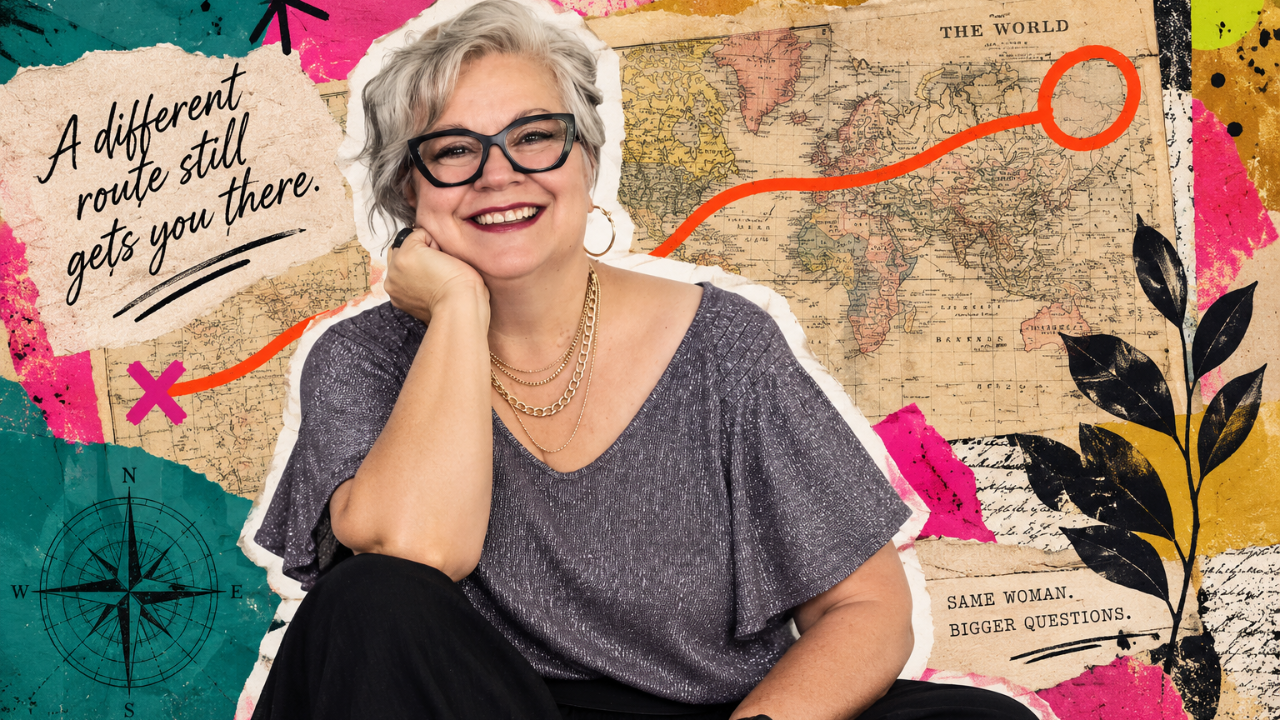
For a long time, I believed that if I did life reasonably well, there would eventually be a point when everything made sense.
You know the deal. Work hard. Be responsible. Love your people. Pay your bills. Keep your promises. Build something meaningful. Try not to be an asshole.
Follow the rules and eventually you arrive at this mythical place where you look around and think, Ah. There it is. I have successfully completed adulthood.
I'm still waiting.
What I have discovered instead is that you can do a hell of a lot of things "right" and still wake up one day wondering why the life you worked so hard to build doesn't quite feel like yours anymore.
It's an especially strange feeling when nothing is obviously wrong. You may actually have a good life. You can love your family, be proud of what you've accomplished and feel genuinely grateful for what you have while some small, irritating voice inside you keeps asking, Yeah... but is this still what I want?
That's usually when we start questioning ourselves.
Because apparently women are allowed to change their hair, their clothes, their kitchens and the paint color in the living room without much explanation.
But change your mind about what you want from your own life?
Whoa. Let's not get reckless.
We Inherited More Rules Than We Realize
Most of us weren't handed an actual rulebook.
Nobody sat us down at twelve and said, "Mary, here are the 147 expectations you'll unconsciously use to evaluate yourself for the next four decades. Good luck."
That would at least have been efficient.
Instead, we picked them up along the way. From our families, religion, culture, school, work, relationships, television, magazines and now an internet filled with strangers explaining how we're supposed to optimize every damn part of ourselves.
Over time, we learned what a successful life looked like and what a "good woman" did. We learned how ambitious she was allowed to be, how much she should sacrifice and, perhaps more importantly, how agreeable she should remain while sacrificing it.
We absorbed ideas about motherhood, marriage, work, aging and when we were supposed to have figured everything out.
And somewhere in all of that, we also learned what we were supposed to want.
Some of those rules served us. Some came from people who loved us deeply, and some helped us build lives we're genuinely proud of.
And some of them were bullshit.
The problem is that after you've followed a rule for thirty years, it stops feeling like a rule.
It starts feeling like truth.
That's Where the Map Comes In
I've always thought about this as a map.
Imagine somebody hands you one when you're young. It looks official enough, and everybody around you seems to have roughly the same one.
The roads are clearly marked: education, career, marriage, family, success, security, retirement. There are probably even little symbols showing where you're supposed to feel accomplished.
Very convenient.
So you start walking, and you're pretty damn good at it. You learn how to navigate. You adapt when the road gets difficult, take detours and survive things that weren't on the map at all.
You become resourceful, capable and dependable.
And somewhere along the way, because you're busy actually living your life, you stop asking who drew the map in the first place.
Then one day you look up.
Maybe you're 45 or 52 or 62. Your children may have left home. A marriage may have ended. Someone you love may have died. Your career may have changed.
Or maybe nothing dramatic happened at all.
You simply look around and think, Where the hell am I?
Not geographically, of course.
Existentially.
Which is much harder to plug into Google Maps.
Feeling Lost Isn't Always About Not Knowing Where to Go
Sometimes you know exactly where you are. You just don't recognize yourself there anymore.
I think that's an important distinction because when a woman says, "I feel lost," we're very quick to start looking for solutions.
Maybe she needs a new career, a new relationship, a new purpose or a better morning routine. Perhaps a new planner will do it. Possibly a retreat involving linen clothing and a suspicious amount of journaling.
We assume she needs another destination.
But what if that's not the problem?
What if the uncomfortable feeling isn't telling you that you need to become someone new? What if it's asking whether the woman you are now still wants to go where the old map is taking her?
That's a very different question.
And frankly, a much more interesting one.
I Don't Think Most of Us Lose Ourselves
This is one of the ideas at the center of ArcheSoul.
I don't believe there's some pristine "real you" hiding underneath forty years of life waiting to be excavated. You've changed. Of course you have.
Life has happened to you.
You've loved people and lost people. You've made brilliant decisions and some spectacularly questionable ones. You've survived things, learned things, changed your mind and outgrown versions of yourself you once desperately needed.
All of that belongs.
Returning to yourself isn't about reversing any of it. It's about becoming willing, and sometimes brave enough, to distinguish between what still belongs to you and what you're carrying simply because you've carried it for a very long time.
That's where archetypes became interesting to me.
Not because I think twelve archetypes can tell a woman who she is. They can't, and I wouldn't want them to.
I'm interested in them because they give us another language for asking questions.
What part of me has been running this show? What part have I ignored? Where am I powerful, and where do I overdo that power? What do I keep repeating? What am I hungry for now? What would happen if another part of me got a damn vote?
That's a very different use of archetypes than slapping a label on yourself and saying, "Great. Apparently I'm a Sovereign. Mystery solved."
You're a human being. You're going to be more complicated than a quiz result.
Thank God.
The Hardest Rules to Question Are the Ones That Worked
I think this is where things get especially uncomfortable.
It's relatively easy to reconsider something that has gone terribly wrong. If the house is on fire, nobody needs to convince you that perhaps redecorating isn't the priority.
But what about the things that worked?
What about the career that gave you security, the role that made you feel needed or the identity that earned you respect? What about the version of yourself who got you through an extraordinarily difficult season?
What happens when something can be both good and finished?
We don't have much language for that because we tend to want a villain. Something needs to have been wrong. Someone needs to have screwed up. Otherwise, why would we change anything?
But sometimes nothing went wrong.
Sometimes the map got you exactly where you needed to go, and then you changed.
That doesn't make the journey a mistake. It simply means you're allowed to decide what happens next.
You Don't Need a Catastrophe to Reconsider Your Life
This is something I wish more women knew.
You don't need to hate your marriage before asking what you need within it. You don't have to despise your career before admitting you may be finished with it. Your children don't have to stop needing you before you decide you need some of yourself back too.
You don't have to be miserable, and you certainly don't need to produce a PowerPoint presentation demonstrating that your dissatisfaction has reached the appropriate threshold for change.
Sometimes I don't want this anymore is simply information.
It isn't automatically a verdict or a crisis. It's something worth paying attention to.
Instead of immediately talking ourselves out of it, maybe we could get curious about it.
Why don't I want this anymore? What changed? What am I protecting? Who am I afraid I'll disappoint? What would I choose if nobody were grading me?
Now we're having an interesting conversation.
I'm Reconsidering a Few Rules Myself
That's part of what Life, Reconsidered is becoming for me.
I want this to be a place where we can examine some of the maps we've been handed, and not only the big philosophical ones.
I want to talk about the everyday rules too. The ones around getting older, work, ambition, relationships, friendship, beauty, money, grief, purpose, being "nice," being needed, starting over, sex and success.
I'm curious about what women are supposedly too old to do and what we're apparently supposed to have stopped wanting by now.
I'd also like to know why women of a certain age seem to be expected to spend the rest of our lives wearing tasteful neutrals and being delighted by charcuterie boards.
I have questions.
And I suspect you do too.
That's what I want Life, Reconsidered to be. Not another place telling you how to live. God knows we have enough of those.
I want it to be a place where we can pick up something we've accepted as true, turn it over a few times and ask, Is it?
And perhaps more importantly, is it still true for me?
These are also the kinds of conversations that have me thinking about the podcast I'm developing. I don't know exactly what shape it will take yet, and I'm okay with that. The idea is to make more room for the questions, not pretend I already have all the answers.
Maybe You Don't Need a New Map
I've changed my thinking about this part.
I used to imagine returning to yourself as putting down someone else's map and finding your own.
Now I'm not sure I even want another map.
A map still suggests there's a predetermined destination out there somewhere that we're supposed to reach, and I'm becoming less interested in destinations.
Maybe what we actually need is a compass.
Something that doesn't tell us exactly where to go but helps us notice whether we're moving toward ourselves or away from ourselves.
Our values. Our instincts. Our curiosity. Our desires. Our inner knowing. All those parts of ourselves that can become surprisingly loud once we stop telling them to be reasonable.
Maybe that's enough.
Because perhaps the goal isn't to finally figure out your life.
Maybe it's to trust yourself enough to keep living it, even when the road changes, even when other people don't understand the turn and even when you change your mind.
Especially when you realize that one of the rules you've spent years faithfully following was, in fact, complete bullshit.
You were never broken.
You were just following directions.
Now you get to decide which ones are still worth following.
Mary
LIFE, RECONSIDERED.
STAY IN THE CONVERSATION.
New conversations, new episodes, and the occasional thought I couldn't leave alone, sent to your inbox.
No noise. Just the occasional note worth opening.
